











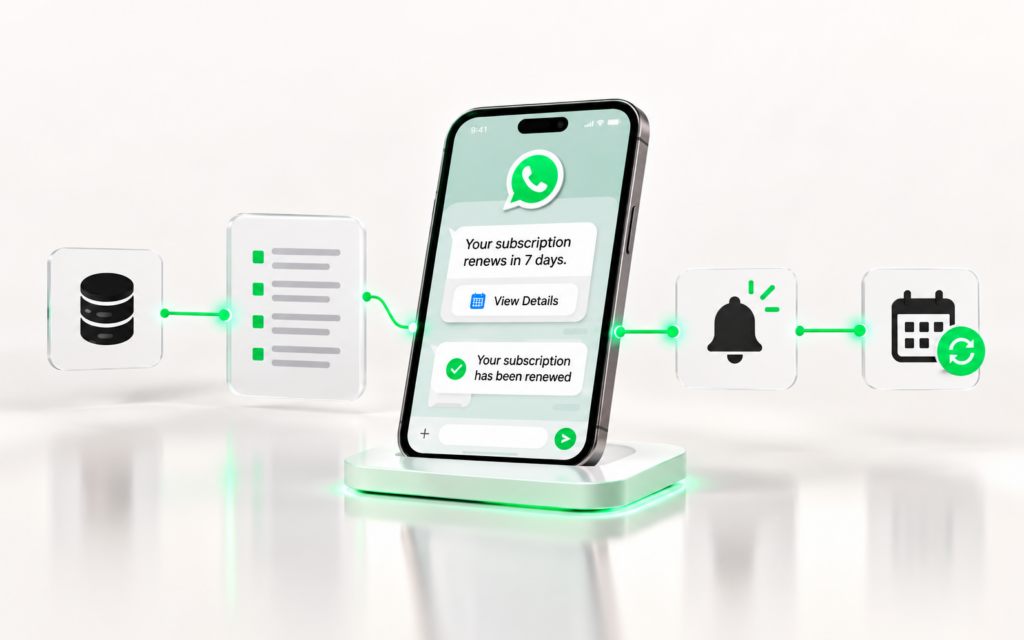
Managing recurring subscriptions can become difficult when receipts, invoices, and renewal details are scattered across messages, emails, screenshots, and PDF documents. Users may forget what they are paying for, when the next charge is due, or how much a service costs until the renewal has already happened.
This use case explores how a connected automation can turn WhatsApp messages, receipt screenshots, and invoice PDFs into structured subscription records, while a separate reminder engine monitors upcoming renewals and sends alerts before each charge date.
The Problem
Tracking recurring subscriptions is tedious. Receipts can arrive as PDFs, screenshots, or plain messages, and some subscriptions may never be logged at all.
By the time a renewal happens, it may be too late to cancel, renegotiate, or review whether the subscription is still needed. Many users also lack one central place to check what they are paying for, how much each plan costs, and when each renewal is due.
The Solution
The WhatsApp Subscription Tracker and Renewal Reminder Engine is a two-part system built around a single subscriptions database.
The first part is a WhatsApp-based conversational agent that lets users add, query, update, or delete subscriptions by chatting, forwarding a receipt image, or uploading an invoice PDF.
The second part is a scheduled reminder engine that watches the same database and sends Telegram reminders 7 days, 3 days, and 1 day before each renewal, while making sure the same reminder is never sent twice.
How the Agent Works
- Receive subscription information through WhatsApp. Users can send plain text, upload a receipt image, or forward an invoice PDF.
- Extract subscription details. The workflow reads the message, image, or document and pulls out relevant details such as vendor, plan, amount, and renewal information.
- Manage subscription records. The conversational agent can add, query, update, or delete subscription records from the database.
- Keep responses simple. Users receive natural, non-technical replies over WhatsApp without seeing database fields or raw system output.
- Monitor upcoming renewals. A separate workflow checks active subscriptions daily and identifies which reminders need to be sent.
- Send renewal alerts. Telegram reminders are sent at 7, 3, and 1 days before renewal, and each reminder is marked as sent to prevent duplicate notifications.
Technical Workflow
1. Multi-modal WhatsApp intake
A WhatsApp trigger receives every inbound message, and a Switch node routes it by type, plain text, an image such as a receipt or screenshot, or a document such as a PDF invoice.
Each type gets its own extraction and conversation path.
2. Receipt image understanding
For image messages, the workflow fetches the media URL from WhatsApp, downloads the binary, and passes it to GPT-4o’s vision analysis to extract all key details from the receipt or screenshot in natural language.
The extracted details then feed into the conversational agent alongside the user’s original caption.
3. Invoice PDF extraction
For document messages, the same download pattern applies, but the file is run through a PDF-text-extraction node instead.
The workflow pulls the raw invoice text and hands it to the agent along with the user’s caption.
4. One shared conversational agent, three entry points
Three parallel instances of the same “conversational subscription assistant” agent, one per message type, share an identical system prompt and tool set.
This gives the user the same natural and consistent experience whether they type a question, forward a screenshot, or upload a PDF.
5. Tool-equipped subscription management
Each agent instance has five tools: add a new subscription record, delete one, query all records, update an existing one, and use SerpAPI web search for external questions like “how do I cancel X?”
The system prompt enforces that the agent must always query the database first to confirm the exact record ID before attempting an update or delete. It must also ask for clarification if multiple records could match.
6. Cross-channel shared memory
All three agent instances share one buffer-window memory, with 10 messages, keyed to the WhatsApp message ID.
This allows context to persist naturally within a conversation regardless of which entry point handled the first message.
7. Natural, non-technical replies
The agent is explicitly instructed to never expose raw JSON or database internals to the user.
It always responds in plain conversational language over WhatsApp with a confirmation or answer.
8. Daily renewal check, companion reminder workflow
A separate, schedule-triggered workflow independently searches the same Airtable base for every subscription marked “active.”
It then computes how many days have elapsed since each subscription’s start date.
9. Calibrated reminder windows
A Switch node checks the elapsed-days figure against three specific thresholds tuned to the billing cycle.
Matching records are routed into a 7-days-out, 3-days-out, or 1-day-out reminder branch.
10. Duplicate-reminder guard
Before any reminder is sent, a filter checks that the relevant reminder flag, “Reminder 1-day,” “3-day,” or “7-day,” is still marked “not sent.”
This means a record that has already been notified for a given window is skipped even if the schedule runs again.
11. Escalating Telegram nudges
Matching records trigger one of three progressively more urgent Telegram messages.
The 7-day message is a friendly heads-up, the 3-day message is a clearer reminder, and the 1-day message is a final warning. Each message names the vendor, plan, and exact renewal amount.
12. Mark reminders sent
After each message goes out, the corresponding record is updated in Airtable.
The workflow flips that specific reminder flag to “sent” and logs the days remaining, so the same alert can never fire twice for the same renewal.
Technology and Integrations
Built with: n8n, WhatsApp Business API, OpenAI GPT-4.1-mini, GPT-4o, SerpAPI, Airtable, Telegram, and connected subscription-management workflows.
Outcome
The WhatsApp Subscription Tracker and Renewal Reminder Engine creates a single source of truth for recurring subscriptions.
A subscription only needs to be mentioned once, whether typed into WhatsApp, sent as a screenshot, or uploaded as an invoice PDF, for it to become part of the tracking system.
The conversational agent handles on-demand subscription questions and updates, while the reminder engine quietly monitors renewals in the background. Shared reminder flags ensure the system can send timely alerts without creating duplicate notifications.
Build Custom AI Automation for Your Business
The WhatsApp Subscription Tracker and Renewal Reminder Engine is one example of how AI automation can support subscription tracking, finance operations, document extraction, reminders, and personal or business workflow management.
We design and build custom AI agents, automation workflows, internal tools, and connected systems for a wide range of business processes.
From sales, marketing, recruitment, customer support, and reporting to finance, operations, data, and internal team workflows, each solution is designed around the way your business works.
Request a Quote for a Custom AI Automation Solution to get started.