











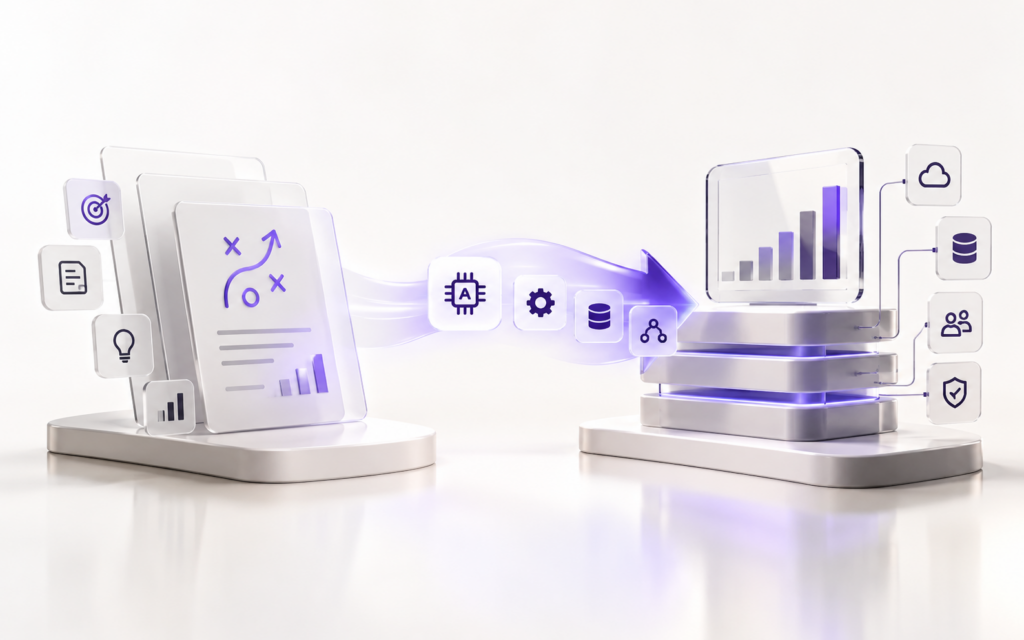
Enterprise AI has moved beyond the stage where access to capable models is the primary constraint. Most organizations can experiment with frontier models, build proofs of concept, deploy copilots, and test agentic workflows, but turning those experiments into dependable systems that operate inside the business remains considerably harder.
OpenAI’s 2026 enterprise data shows this transition accelerating as organizations move beyond assistance toward delegated work, with agents increasingly connected to company context, tools, and repeatable workflows. The challenge for enterprise leaders is therefore shifting toward the technical and organizational capabilities required to make AI reliable enough to become part of normal operations.
The Gap Between AI Strategy and Production Capability
An AI strategy can establish priorities, use cases, investment areas, platforms, and governance principles, but production capability determines whether those priorities can be translated into systems that perform under real operating conditions. Production introduces changing data, enterprise permissions, application dependencies, unexpected inputs, operational risk, and accountability that are often less visible during experimentation.
Deloitte’s 2026 State of AI in the Enterprise found that 42% of surveyed organizations considered their AI strategy highly prepared, while readiness remained lower across infrastructure, data, risk, and talent. Only 34% reported truly reimagining the business through AI, showing that strategic intent and operational capability are progressing at different speeds.
Production capability closes that gap by giving enterprises a repeatable way to integrate, govern, evaluate, operate, and improve AI systems rather than treating every initiative as a separate experiment.
Production Begins With the Workflow
AI initiatives often begin with a model or platform and then search for business processes where the technology can be applied. That sequence may produce a strong demonstration, but production systems need to begin with a clearer understanding of the workflow and the business outcome it is expected to improve.
Leadership needs to understand how the process operates today, which decisions are involved, what information is required, where exceptions occur, which applications support the work, and where human judgment remains necessary. These factors determine where agents, traditional automation, deterministic software, and human intervention should sit.
This becomes more important as AI agents assume greater responsibility. An agent that produces a document presents a different operating challenge from one that retrieves customer data, interprets business rules, updates enterprise software, initiates another workflow, and decides when an exception requires escalation.
Integration and Reliability Determine Whether AI Can Operate
AI becomes operationally useful when it can interact with the systems where work actually happens. Those environments are often distributed across CRM platforms, ERP systems, data warehouses, communication tools, document repositories, internal applications, and industry-specific systems.
Integration therefore extends beyond giving a model access to an API. Enterprises need to determine which information the system can retrieve, which actions it can perform, how identity and permissions are managed, how workflow state is maintained, and what happens when another system fails.
Reliability must also be evaluated beyond model accuracy. A capable model can still sit inside an unreliable system if retrieval fails, an integration times out, business context is incomplete, permissions are incorrect, or the workflow has no recovery mechanism.
Production performance should therefore be measured at the workflow level. Enterprises need visibility into completion rates, exception patterns, human intervention, quality, recovery, and the business consequences of system failure.
Governance Has to Operate Inside the Workflow
Governance becomes more operational as AI systems gain the ability to take action. Policies alone are not enough when an agent can update records, communicate externally, access sensitive information, initiate transactions, or invoke other enterprise systems.
Permissions, identity, approval thresholds, data boundaries, escalation logic, audit trails, and tool restrictions increasingly need to become part of the production architecture. Governance has to influence what the system can actually do while work is being performed.
This requires a different relationship between technology and business ownership. Technical teams may own architecture, security, integrations, deployment, and evaluation infrastructure, while business teams remain accountable for process performance, operating rules, escalation requirements, and measurable outcomes.
AI Needs to Expand Organizational Capacity
Production AI should eventually create more than individual productivity gains. The larger opportunity is to increase the volume, complexity, or quality of work the organization can handle without requiring resources to grow at the same rate.
Microsoft’s 2026 Work Trend Index found that organizational factors such as culture, manager support, and talent practices accounted for more than twice the reported AI impact of individual effort. The research reinforces the idea that enterprise value depends on redesigning the environment around the technology, not simply giving more employees access to AI.
When AI improves operational output, cycle time, service quality, revenue capacity, or cost structure at the process level, it begins creating operating leverage. Capturing that value requires organizations to redesign work around what AI can execute rather than using AI only to make existing tasks faster.
Production Capability Should Compound
Enterprises should avoid rebuilding the complete production environment around every new AI use case. Integration patterns, identity models, evaluation infrastructure, observability, context layers, governance controls, and reusable agent components can become shared capabilities.
The first production deployment may require substantial engineering because the organization is building both the solution and the foundation around it. Subsequent systems should be able to reuse more of that infrastructure, reducing implementation complexity and improving the economics of future deployments.
The same principle applies organizationally. Clear decision rights, ownership models, evaluation standards, and workflow-design methods become reusable capabilities that make the enterprise better at moving AI into production repeatedly.
How Divverse Labs Turns AI Strategy Into Production Capability
Production AI requires the intelligence layer and the operating environment around it to work together. Architecture, integrations, agents, automation, enterprise context, evaluation, governance, and business ownership all influence whether a system can perform reliably after the pilot stage.
At Divverse Labs, taking AI from pilot to production means building that complete implementation layer around the business problem. We design agents, automations, custom software, integrations, and enterprise workflows that can operate inside real business environments and contribute to measurable outcomes.
The longer-term advantage does not come from accumulating more AI experiments. It comes from developing the ability to identify valuable opportunities, operationalize them reliably, measure what changes, and reuse those capabilities across the next generation of AI systems.